Is Your Solar System Working Properly?
Why Solar Monitoring Matters
Is Your Solar System Working Properly? Why Solar Monitoring Matters
Published: September 2026 | Technical Review by Chad Foster, Service Manager, Alternative Energy Systems
Your solar panels may be sitting in the sun and your system may appear to be running, but is it producing as much energy as it should?
A solar system can continue producing electricity while still underperforming. Solar monitoring helps track energy production, equipment alerts, communication problems, and outages so potential issues can be identified and investigated sooner.
For homeowners, businesses, farms, and commercial property owners in Northern California, monitoring provides valuable insight into how a solar energy system is actually performing, not simply whether it appears to be turned on.
Without functioning monitoring and regular review, an underperforming solar system could go unnoticed until a higher electric bill, unexpected True-Up balance, or significant drop in production reveals that something may be wrong.
What Is Solar System Monitoring?
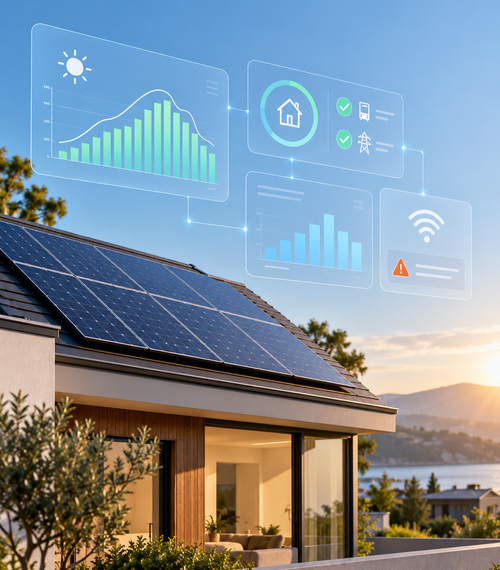
Solar system monitoring tracks information about a solar energy system’s operation and electricity production.
Depending on the system and its equipment, a monitoring platform may display:
Current and historical energy production
Inverter status and equipment alerts
Unexpected drops in performance
Communication failures
System outages
Production patterns over time
Think of your solar monitoring portal much like the dashboard in your car. Status lights, alerts, and notifications can help tell you when something may need attention.
Monitoring provides visibility into system performance, but simply having access to a monitoring platform does not necessarily mean someone else is actively watching it.
What Can Solar Monitoring Tell You?
A solar energy system does not always stop working completely when a problem occurs.
It may continue generating some electricity even when an inverter, panel group, electrical component, or monitoring connection needs attention. Because the system may still be producing power, a problem is not always immediately obvious.
| Solar monitoring may show | Additional troubleshooting may determine |
|---|---|
| Unexpected production loss | Why production has declined |
| Inverter alerts or fault codes | Whether equipment requires repair or replacement |
| Communication failures | Whether the issue involves monitoring, communications, or solar equipment |
| Partial or complete outages | Which component may be responsible |
| Changes in production patterns | Whether the change is normal, environmental, electrical, or equipment-related |
For system owners, a good practice is to check the monitoring portal at least once a month, ideally when reviewing the monthly utility statement.
Look for warning lights, alerts, missing data, communication errors, or production that appears noticeably different from previous comparable periods.
A single change does not always mean that equipment has failed, but persistent or unexplained changes may indicate that the system should be evaluated.
Who Is Responsible for Monitoring My Solar System?
Who is responsible for monitoring a solar system depends in part on how the system is owned and the agreement associated with it.
Leased Systems and Power Purchase Agreements
If a system is leased or is part of a Power Purchase Agreement, or PPA, facilitated by AES, it includes a production guarantee that the third-party owner is responsible for maintaining.
Customers should still pay attention to their system performance and report anything unusual, but the ownership and maintenance responsibilities are different from those of a customer-owned system.
Customer-Owned Solar Systems
If you purchased your solar system from AES, the system came with applicable manufacturer and workmanship warranties. However, active third-party monitoring is not automatically included with an owned system.
The system owner should review the monitoring portal periodically to make sure everything appears to be operating as expected.
AES recommends checking the portal at least once per month, ideally when your utility statement arrives.
Warranty coverage also varies. Depending on the equipment, warranty, and circumstances, equipment may be covered while labor costs may or may not be included.
If AES did not originally install the system, it may or may not have a production guarantee, active monitoring arrangement, or applicable warranty coverage. The original purchase, lease, PPA, warranty, or service documents can help clarify what applies.
How to Check Your Solar Performance at a Glance
You do not need to analyze every production graph to keep an eye on your solar system.
A simple monthly check can go a long way:
Log in to your solar monitoring portal.
Look for warning lights, alerts, fault messages, or notifications.
Confirm that current production data is being reported.
Compare recent production with previous similar periods when possible.
Review your utility statement for unexpected changes.
If you see anything out of the ordinary, cannot access your monitoring portal, or are unsure what an alert means, submit a service request to AES.
If you have never logged in to your monitoring portal, or have not checked it in a while, it is worth taking a look. An unnoticed production problem can result in more electricity being purchased from the utility and may contribute to an unexpected True-Up balance.
Why Did My Electric Bill or True-Up Increase If I Have Solar?
A higher electric bill or True-Up does not automatically mean that a solar system is malfunctioning.
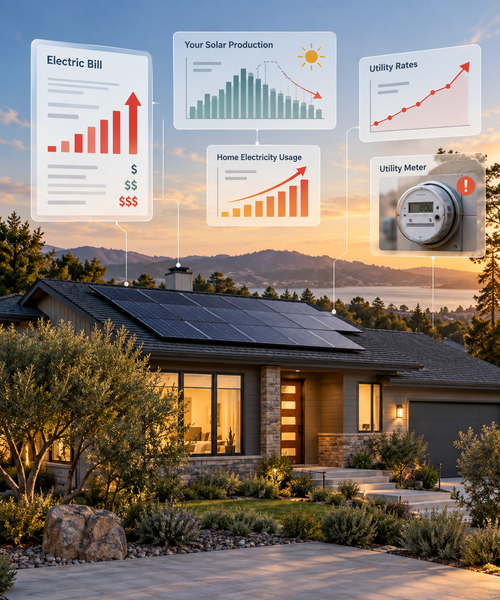
Electricity costs can increase because of:
Greater household or business energy use
Weather
New appliances
Electric vehicle charging
Changing operating hours
Additional occupants
Utility rate changes
Reduced solar production
A combination of several factors
In AES’s experience, higher utility costs are not always caused by the solar system itself. Changes in energy use and utility rates can play a significant role as well.
This is why functioning solar monitoring is so important.
A utility such as PG&E can see electricity on the utility side of the meter, but it does not have the same visibility into how the solar equipment itself is operating.
When solar monitoring is functioning, AES can often begin distinguishing between changes in solar production and changes in electricity use without first dispatching a technician.
If monitoring is unavailable, an on-site evaluation may be necessary.
A Real AES Example: When a Higher True-Up Signals the Need for a Closer Look
A recent AES customer contacted our service team after seeing a significant increase in their annual True-Up bill.
Their True-Up had increased from approximately $450 the previous year to more than $2,000.
The customer’s AES solar system had been installed about six years earlier. They reported that production had dropped and wanted to know why, whether the problem could be fixed, and whether the panels were still under warranty.
Because AES originally installed the system, our team was able to look up the system remotely. We found that the monitoring system had stopped reporting data in 2025.
That does not tell us yet exactly why the customer’s True-Up increased. Higher energy use, utility rate changes, reduced solar production, or a combination of factors may all contribute.
But without functioning monitoring, it becomes much more difficult to determine remotely what the solar system has been doing.
The customer had already contacted PG&E and was directed back to their solar provider. That makes sense because the utility can see its side of the meter but cannot determine how the customer’s solar equipment is performing.
AES scheduled a Performance Health Check to evaluate the system on-site.
During a Performance Health Check, a technician can evaluate or restore monitoring access and inspect the solar equipment for other potential performance issues.
When functioning monitoring is available, AES can often begin diagnosing the situation remotely. When monitoring cannot be accessed, a technician generally needs to visit the property to assess both the monitoring system and the solar equipment.
The takeaway: A higher electric bill or True-Up does not automatically mean the solar system has failed. But it is a good reason to check the monitoring portal and investigate unexplained changes in system performance.
What Does AES Look for When a Solar System Is Underperforming?
Monitoring data can indicate that something has changed, but determining the cause may require additional evaluation.
Depending on the system and the issue, the Alternative Energy Systems service team may review:
System performance and production history
Equipment alerts
Inverter operation
Electrical components
Wiring and connections
Monitoring communications
Equipment warranty status
Other available system information
AES solar Operations & Maintenance services may include:
System performance inspections
Electrical testing and diagnostics
Inverter and equipment evaluations
Wiring and connection inspections
Monitoring-system verification
Preventive maintenance
Corrective maintenance and repairs
Commercial solar Operations & Maintenance support
If equipment has failed and the issue is covered by an applicable warranty, some or all of the repair may be covered depending on the warranty terms.
The appropriate next step depends on the system’s size, age, equipment, location, operating history, warranty coverage, and the symptoms being reported.
Why Are Professional Solar Monitoring and System Support Important?
Solar monitoring is most useful when the information leads to action.
A qualified solar service provider can help interpret performance information, investigate unusual changes, and determine whether troubleshooting, an inspection, maintenance, or a repair is needed.
Professional solar system support can help property owners:
Recognize outages and equipment alerts sooner
Identify potential production losses
Understand whether a system is meeting reasonable performance expectations
Make informed maintenance and repair decisions
Reduce the risk of a problem remaining unnoticed
Protect the long-term value of an existing solar investment
Monitoring cannot resolve every issue remotely. Some concerns require on-site troubleshooting, preventive inspection, maintenance, equipment replacement, or corrective repair.
Get a Clearer Picture of Your Solar System’s Performance
Whether your solar system serves a home, business, farm, or commercial property, you should know whether it is operating as expected.
Alternative Energy Systems Inc. provides solar monitoring support, diagnostics, troubleshooting, maintenance, and repair services for residential, commercial, agricultural, and other solar energy systems throughout Northern California. AES also services many existing solar systems originally installed by other solar providers.
If your original solar installer is no longer in business, AES may also be able to help evaluate and service your system.
If you are unsure whether your solar system is being monitored, cannot access your monitoring portal, have received an alert, or believe your system may not be producing as expected, contact AES at 530-345-6980 or submit a service request at savingenergyforlife.com.
Frequently Asked Questions About Solar Monitoring
How do I know if my solar panels are working correctly?
Start with your monitoring portal.
Check current production, equipment status, alerts, fault messages, and communication errors. AES recommends that owners review their monitoring portal at least once a month, ideally when the utility statement arrives.
If you notice warning lights, missing data, unexpected production changes, or anything else that appears unusual, the system may need further evaluation.
Does having a solar monitoring app mean my system is being actively monitored?
Not necessarily.
A monitoring app gives you access to system information, but that does not always mean someone is actively reviewing the data on your behalf.
For customer-owned systems purchased from AES, active third-party monitoring is not automatically included. Owners should review their monitoring portal regularly and report unusual alerts or performance changes.
If the system is leased or part of a PPA facilitated by AES, monitoring and performance responsibilities may be handled differently because the third-party owner is responsible for maintaining the system under the applicable production guarantee.
Can part of my solar system stop working while the rest keeps producing electricity?
Yes.
Some equipment problems can reduce the production of part of a solar system without shutting down the entire system.
Because the system may continue producing electricity, partial outages or equipment problems can be difficult to notice without functioning monitoring.
What should I do if my solar monitoring portal shows an alert or stops reporting data?
Check the portal for warning lights, fault messages, communication errors, or other notifications.
A monitoring communication problem does not always mean that the solar system itself has stopped producing electricity, but it does mean you may no longer have reliable visibility into its performance.
If the issue does not resolve, you cannot access your portal, or something looks unusual, submit a service request to AES.
Why did my electric bill increase even though I have solar?
A higher bill can result from increased electricity use, weather, changing utility rates, electric vehicle charging, new appliances, business activity, reduced solar production, or a combination of factors.
Comparing utility usage with solar production data can help narrow down the possible cause. Functioning monitoring gives your solar provider much better visibility into what the solar system itself has been doing.
Can AES service a solar system it did not originally install?
Yes.
AES provides maintenance, diagnostics, troubleshooting, and repair support for many existing solar energy systems, including systems originally installed by other providers.
If your original installer is no longer in business, or you are unsure who is responsible for servicing the system, contact AES with information about your equipment, monitoring platform, and service needs so the team can determine the appropriate next step.
Email Us: getstarted@savingenergyforlife.com
Visit Us: Alternative Energy Systems Inc., 13620 Hwy 99 Chico, CA 95973
About the Technical Reviewer
Chad Foster, Service Manager, Alternative Energy Systems
Chad Foster is a State of California General Electrician Journeyman with advanced training in solar system service, operations and maintenance, electrical systems, monitoring, diagnostics, thermography, and solar equipment.
His training and certifications include:
Amicus Solar O&M Certified: Tech 1, Tech 2, Tech 3
WECA Certified: Service Technician; Low Voltage and Communications; NEC; Solar Technician
Solar Energy International Certified: Thermography & Drones; SEI 350 O&M Strategies; Groundmount Solar Installation Safety
Manufacturer Certifications: Enphase, Tesla, SMA, SolarEdge, ALSO Energy, and solar modules